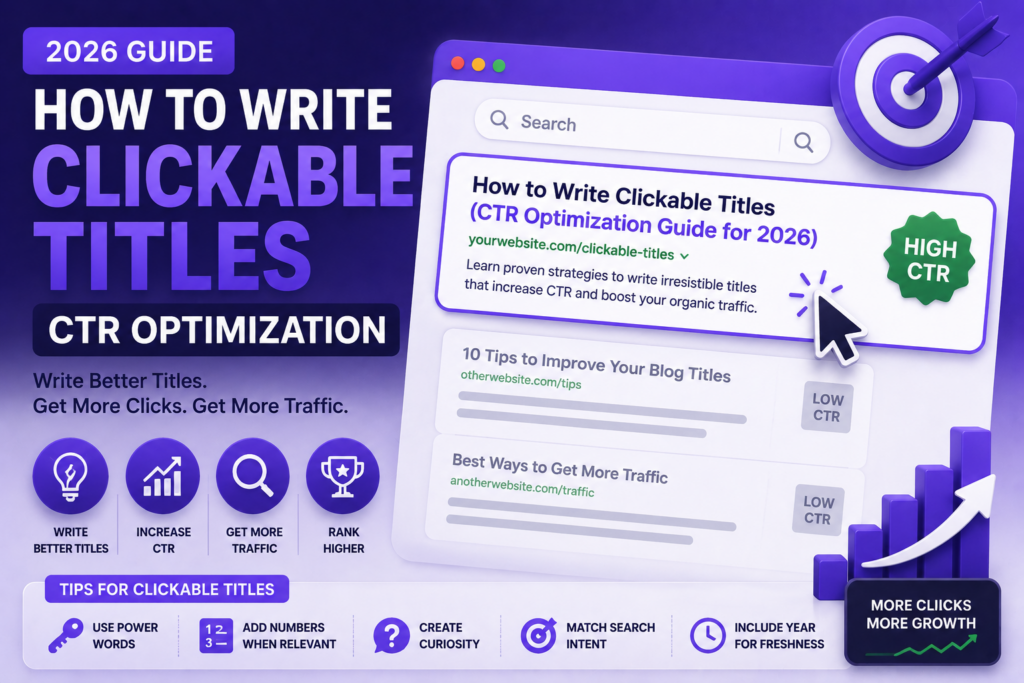
How to Write Clickable Titles (CTR Optimization Guide for 2026)
You can write the most detailed article on the internet and still receive disappointing traffic.
That sounds unfair, but it happens constantly.
Why?
Because users make decisions quickly.
Before someone reads your content, they first see your title in search results, social feeds, Google Discover, or recommendation sections. Within seconds they decide whether your article deserves attention.
Your title acts like a storefront sign. Even excellent content struggles if nobody walks inside.
This is where Click-Through Rate, commonly called CTR, becomes important.
CTR measures how often users click after seeing your page in search results.
Google Search Console provides this data directly.
According to Google Search Console documentation, impressions and clicks help website owners understand performance opportunities.
This guide explains how to write titles that attract attention while remaining trustworthy and SEO-friendly.
📌 What Is CTR?
CTR stands for Click-Through Rate.
It represents the percentage of users who click after seeing your page.
For example:
If your page appears 1,000 times and receives 100 clicks, your CTR becomes 10%.
A stronger CTR often means your title and presentation successfully attract users.
Improving CTR can increase traffic without improving rankings.
That makes it one of the highest-return SEO improvements available.
🎯 Why Titles Matter More Than People Realize
People rarely read entire search result pages carefully.
They scan quickly.
The eye usually notices headlines first.
Strong titles create curiosity, clarity, and relevance.
Weak titles disappear among competitors.
Search engines increasingly evaluate user interaction signals.
If users repeatedly ignore your result while clicking competitors, performance may weaken over time.
🧠 The Psychology Behind Clickable Titles
Good titles are not random.
They often trigger emotional or practical reactions.
People click because they expect:
A solution.
A shortcut.
A lesson.
A warning.
A comparison.
A specific benefit.
Understanding motivation helps create stronger headlines.
📈 Start With Search Intent
Before writing a title, understand why users are searching.
Search intent shapes expectations.
If users search “how to secure WordPress,” they likely want actionable instructions.
Titles should reflect that intent immediately.
Poor example:
WordPress Thoughts and Security Ideas
Improved version:
How to Secure Your WordPress Website From Hackers (Complete Guide)
The second version communicates purpose instantly.
🔍 Include Primary Keywords Naturally
Keywords still matter.
Search engines use titles to understand page relevance.
Place your primary keyword naturally near the beginning when possible.
However, avoid forcing it.
Keyword stuffing creates awkward titles.
For example:
SEO Tips SEO Guide Best SEO Tips SEO Strategy
This feels unnatural.
Modern search systems understand context.
Natural writing performs better.
⚡ Use Numbers Carefully
Numbers often attract attention because they create structure and specificity.
Examples:
7 WordPress Security Mistakes Beginners Make
10 SEO Tips That Actually Work in 2026
Numbers imply organization.
Users often perceive them as easier to consume.
However, use numbers only when they genuinely fit content.
📱 Add Time Relevance When Appropriate
Many users want current information.
Including years like 2026 can increase perceived freshness.
Examples:
Best Blogging Tools for 2026
SEO Checklist for Beginners (2026 Guide)
This works especially well for rapidly changing topics.
🚀 Create Curiosity Without Misleading Users
Curiosity works.
Clickbait usually fails long term.
There is a difference.
Curiosity creates interest.
Clickbait creates disappointment.
Bad example:
You Won’t Believe This SEO Secret!!!
Better example:
The SEO Mistake That Quietly Hurts Rankings
The second creates interest without manipulation.
🔗 Learn From Existing Search Results
Before publishing content, study top-ranking titles.
Search your target keyword and examine patterns.
Do top pages use:
Guides?
Lists?
Tutorials?
Questions?
Comparisons?
Understanding patterns helps identify expectations.
However, do not simply copy competitors.
Create stronger value.
📊 Measure Performance Through Search Console
Many bloggers write titles and never revisit them.
Instead, analyze CTR regularly.
Use Google Search Console to identify pages with:
High impressions.
Low clicks.
These pages often represent major opportunities.
Small title changes sometimes create surprisingly large improvements.
🤖 Titles in the AI Search Era
Search behavior continues evolving.
AI systems increasingly understand meaning and context.
However, humans still decide whether to click.
Strong titles should satisfy both search engines and people.
Google’s Helpful Content guidance emphasizes creating content designed for users.
Titles should follow the same principle.
⚠️ Common Title Mistakes
Keyword stuffing.
Misleading clickbait.
Extremely long titles.
Vague wording.
No emotional or practical value.
Ignoring search intent.
Weak titles often reduce traffic potential significantly.
💡 Practical Advice for Preneurs
For Preneurs, title optimization becomes especially important because content aims to attract both informational and commercial traffic.
Titles should combine search intent with curiosity and practical outcomes.
Examples:
How to Fix Error Establishing Database Connection in WordPress
Best Hosting for WordPress Beginners
How to Get Google AdSense Approval for Your Blog
These titles communicate immediate value.
❓ FAQs
1. What is CTR?
Click-through rate.
2. Does CTR affect SEO?
Indirectly, yes.
3. Should keywords appear in titles?
Yes, naturally.
4. Do numbers improve CTR?
Often yes.
5. Is clickbait good?
No.
6. How long should titles be?
Usually under 60–65 characters.
7. Can title changes improve traffic?
Yes.
8. Should I include years?
Sometimes.
9. Can AI write titles?
Yes, with human review.
10. Should I test titles?
Absolutely.
Final Thoughts
Titles are often underestimated because they seem small.
However, traffic frequently depends on tiny decisions.
Great content deserves strong presentation.
Do not just rank. Get clicked.