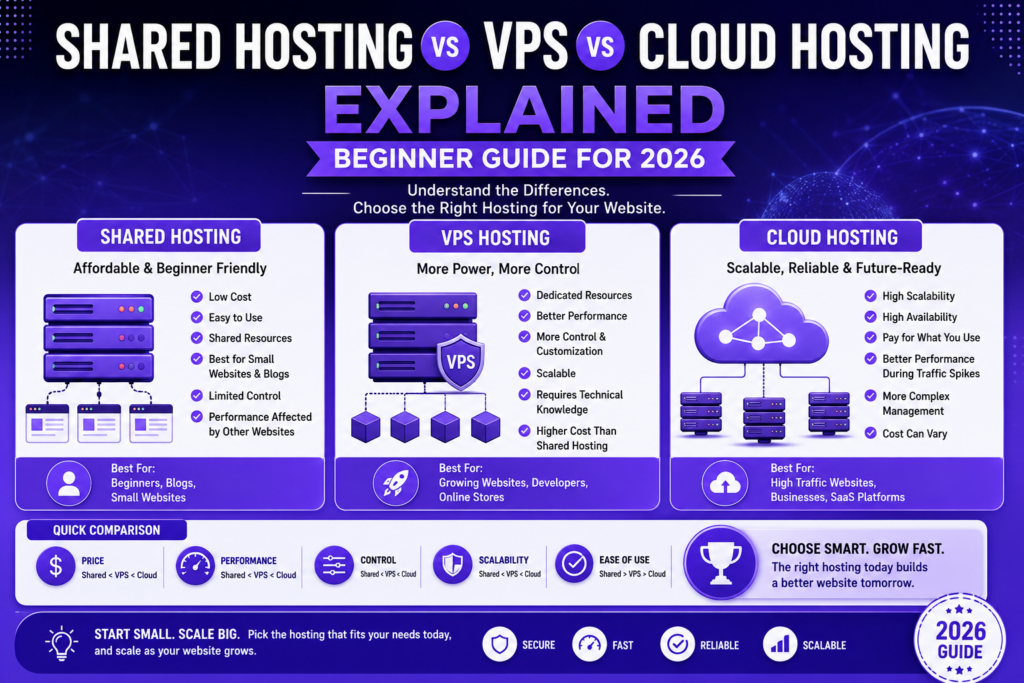
Shared Hosting vs VPS vs Cloud Hosting Explained (Beginner Guide for 2026)
For beginners, buying hosting often becomes confusing surprisingly fast.
You start searching for hosting plans and suddenly see terms like Shared Hosting, VPS Hosting, Cloud Hosting, Dedicated Servers, Managed Hosting, containers, resources, and bandwidth.
Many people simply choose the cheapest option because all hosting plans initially appear similar.
Later problems begin.
Slow websites.
Unexpected downtime.
Performance limitations.
Resource restrictions.
Scaling challenges.
The problem is not always hosting quality.
Sometimes websites simply use the wrong hosting type.
This guide explains hosting options in beginner-friendly language so you can understand differences before making decisions.
For additional fundamentals, review Google’s guidance on website performance and user experience:
📌 First: What Hosting Actually Does
A website needs files.
Files need storage.
Visitors need access.
Hosting companies provide servers that store and deliver website data.
Whenever someone opens your website, files load from servers.
Without hosting, websites cannot remain publicly available online.
Hosting simply becomes the infrastructure supporting everything users experience.
🏠 Understanding Shared Hosting Using a Simple Example
Imagine an apartment building.
Multiple families live inside one building and share common infrastructure.
Water systems.
Electricity.
Facilities.
Resources.
Shared hosting works similarly.
Multiple websites operate on one server.
Resources become shared.
This makes shared hosting affordable.
🎯 Advantages of Shared Hosting
Shared hosting often works well for:
Beginners.
Blogs.
Small business websites.
Portfolio websites.
Starter projects.
Advantages include:
Lower cost.
Easy setup.
Minimal technical knowledge required.
Simple management.
Many first websites begin here.
⚠️ Shared Hosting Limitations
Shared environments create trade-offs.
If neighboring websites consume large resources, performance may occasionally suffer.
Traffic spikes sometimes create limitations.
Heavy projects eventually outgrow shared systems.
This does not mean shared hosting is bad.
It simply means every option serves different situations.
🚀 What Is VPS Hosting?
VPS stands for Virtual Private Server.
Imagine moving from a shared apartment building into a private section with dedicated space.
You still operate within larger infrastructure.
However, resources become more isolated.
VPS environments generally provide:
Greater control.
More resources.
Better customization.
Improved flexibility.
More predictable performance.
📈 VPS Advantages
Growing websites often consider VPS because of:
Better performance.
Resource allocation.
Customization capabilities.
Scalability improvements.
Additional control.
Businesses with increasing traffic sometimes upgrade here.
⚠️ VPS Challenges
VPS environments frequently require greater technical understanding.
Server management sometimes becomes more involved.
Configuration complexity increases.
Costs usually rise compared with shared hosting.
Beginners sometimes choose VPS too early.
☁️ What Is Cloud Hosting?
Cloud hosting differs from traditional approaches.
Instead of relying heavily on one physical server, websites often use distributed infrastructure.
Resources become more flexible.
Scaling frequently becomes easier.
Traffic spikes may become easier to handle.
Cloud systems increasingly power modern applications and growing businesses.
⚡ Cloud Hosting Advantages
Cloud hosting often provides:
Flexibility.
Scalability.
High availability.
Resource adaptability.
Improved resilience.
This becomes attractive for websites expecting growth.
🔍 Cloud Hosting Considerations
Cloud environments vary significantly.
Pricing structures sometimes become complex.
Technical requirements may increase.
Configurations differ widely between providers.
Beginners occasionally feel overwhelmed initially.
📱 Which Hosting Option Is Best for Beginners?
Most beginners overestimate their requirements.
A new blog with modest traffic rarely needs advanced infrastructure immediately.
Shared hosting often provides enough flexibility for early growth.
As traffic increases, upgrades remain possible later.
Start appropriately.
Scale when necessary.
🧠 Hosting and SEO Connection
Hosting affects:
Speed.
Uptime.
User experience.
Core Web Vitals.
Reliability.
Search engines increasingly evaluate page experience.
Infrastructure quietly influences performance.
💡 Practical Advice for Preneurs Readers
Preneurs website packages primarily focus on complete beginner-friendly solutions.
For many new users, a simple managed shared environment often provides a practical starting point.
Instead of purchasing separate hosting, themes, and configurations independently, complete WordPress-ready setups can simplify the process.
As websites grow, infrastructure choices can evolve.
❓ FAQs
1. Is shared hosting good?
Yes for many beginners.
2. Is VPS faster?
Usually yes.
3. Does cloud hosting scale better?
Often yes.
4. Should beginners buy VPS?
Not always.
5. Does hosting affect SEO?
Indirectly yes.
6. Can I upgrade later?
Usually yes.
7. Is cloud hosting expensive?
Depends.
8. Which hosting is easiest?
Shared hosting.
9. Does traffic matter?
Very much.
10. Is hosting one-size-fits-all?
No.
Final Thoughts
Choosing hosting is not about selecting the most powerful option.
It is about selecting the most suitable option.
Start where your website currently is, not where you hope it might eventually become.