How to Build Backlinks (Beginner Guide for 2026)
If you spend enough time reading about SEO, you will repeatedly come across one word: backlinks. For years, backlinks have remained one of the strongest signals used by search engines to evaluate trust and authority. However, beginners often misunderstand backlinks and think link building means collecting as many links as possible.
That approach no longer works.
In 2026, search engines are much smarter. Quality matters far more than quantity. One relevant backlink from a trusted website can sometimes be more valuable than hundreds of weak or spammy links.
According to Google Search Spam Policies, manipulative link schemes can negatively affect rankings. This means your strategy should focus on earning trust rather than trying shortcuts.
In this guide, you will learn what backlinks are, why they matter, and how beginners can build backlinks naturally and safely.
📌 What Are Backlinks?
A backlink is a link from another website pointing to your website.
Imagine someone recommends your business publicly. That recommendation creates trust. Backlinks work in a similar way.
When respected websites link to your content, search engines interpret it as a signal that your content may be useful and trustworthy.
Not all backlinks carry equal value. The quality, relevance, and authority of the linking website matter significantly.
🎯 Why Backlinks Matter for SEO
Search engines want to rank content that users trust. Backlinks help them estimate trust and authority.
Backlinks can improve rankings, increase referral traffic, strengthen authority, and accelerate indexing.
However, backlinks alone cannot compensate for weak content. Good SEO still begins with valuable content.
🧠 Understanding Different Types of Backlinks
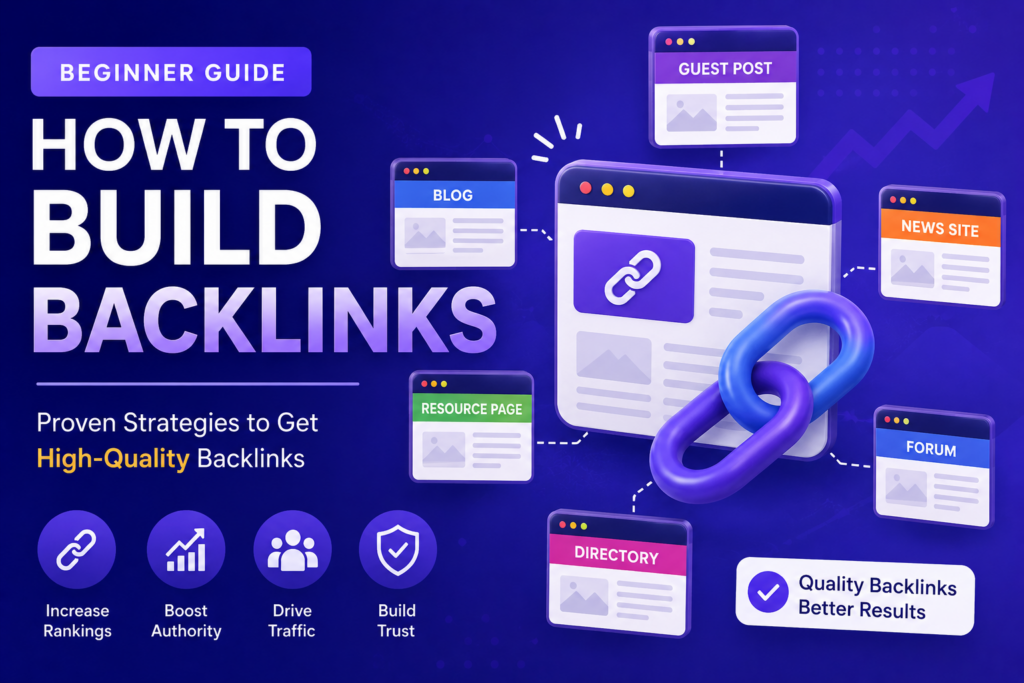
Editorial Backlinks
These are among the strongest backlinks because they are earned naturally. A website references your article because it genuinely finds value in your content.
For example, if you publish an excellent guide on WordPress optimization and another blog references it as a source, that is an editorial backlink.
Guest Post Links
Guest posting means contributing content to another website and receiving a link back to your own website.
When done properly, guest posting can build authority and expose your brand to new audiences.
Directory Links
Business directories and niche listings can provide backlinks. However, quality matters.
Avoid low-quality directories designed only for SEO manipulation.
Forum and Community Links
Communities such as Reddit or niche discussion forums can generate visibility and occasional links.
However, focus on helping people rather than dropping links everywhere.
🔍 What Makes a Good Backlink?
Many beginners chase numbers, but strong backlinks have certain characteristics.
First, relevance matters. A link from a website related to your industry is usually stronger than a random unrelated website.
Second, authority matters. Websites with established trust generally pass stronger value.
Third, context matters. A naturally placed link within content usually performs better than a random footer link.
Finally, traffic matters. A backlink from a website with real visitors can send direct referral traffic in addition to SEO value.
📈 Proven Link Building Strategies for Beginners
Create Content Worth Linking To
The strongest long-term strategy is creating content people naturally want to reference.
Examples include:
Detailed tutorials, original research, practical tools, case studies, complete guides, and useful resources.
If your content solves real problems better than competing articles, people will naturally reference it.
This approach supports EEAT because it demonstrates expertise and value.
Guest Blogging
Guest blogging still works when done strategically.
Instead of targeting random websites, focus on relevant websites with engaged audiences.
Contribute genuinely helpful content rather than promotional articles.
Learn more through HubSpot’s guest blogging guide.
Use Resource Pages
Many websites maintain resource pages listing helpful articles and tools.
If your content genuinely adds value, you can reach out and suggest inclusion.
This approach often works well for tutorials and evergreen content.
Broken Link Building
Websites sometimes contain outdated or broken links.
You can identify those broken resources and offer your own content as a replacement.
This helps both parties.
The website owner fixes a problem while you gain an opportunity.
Create Statistics and Data-Based Content
People frequently reference data and statistics in their articles.
Original data often attracts backlinks naturally.
Even curated industry statistics can generate strong linking opportunities.
⚡ Link Building for New Websites
New websites often struggle because they have little authority.
If your website is new, start with content quality before aggressively pursuing backlinks.
Build foundational content first.
For Preneurs, examples include:
WordPress tutorials, SEO guides, hosting content, and troubleshooting resources.
Strong content makes future outreach significantly easier.
🤖 Link Building in the AI Search Era
AI-driven search systems increasingly evaluate content quality, trust signals, and topical relationships.
This means artificial link building strategies are becoming less effective.
Search engines now understand content context better than before.
Helpful content supported by natural authority signals will likely outperform manipulative tactics.
Google’s Helpful Content System guidance reinforces this approach.
⚠️ Common Link Building Mistakes
Many beginners buy backlinks from random sellers.
Others use automated tools, spam comments, or join low-quality link networks.
These shortcuts often create long-term damage.
Another mistake is focusing entirely on backlinks while ignoring content quality.
Without strong content, backlinks become far less effective.
💡 Practical Strategy for Preneurs
Since Preneurs publishes educational WordPress and SEO content, a practical strategy would involve:
Publishing detailed guides, creating comparison articles, writing troubleshooting content, and gradually reaching out to related websites.
Over time, topical authority itself becomes a backlink magnet.
❓ FAQs
1. What is a backlink?
A link from another website pointing to your website.
2. Do backlinks still matter?
Yes, they remain important ranking signals.
3. Is buying backlinks safe?
Usually not recommended.
4. How many backlinks do I need?
Quality matters more than quantity.
5. Can beginners build backlinks?
Yes, through content and outreach.
6. What is guest blogging?
Writing content for another website.
7. What is broken link building?
Replacing outdated links with your content.
8. Are directory links useful?
Only high-quality directories.
9. Can backlinks improve rankings?
Yes, when earned naturally.
10. What is the safest strategy?
Create valuable content people want to reference.
Final Thoughts
Backlinks are not about shortcuts or numbers. They are about trust. When your content consistently helps users, solves problems, and demonstrates expertise, links become a natural outcome.
Build content first, authority second, and backlinks will follow naturally.