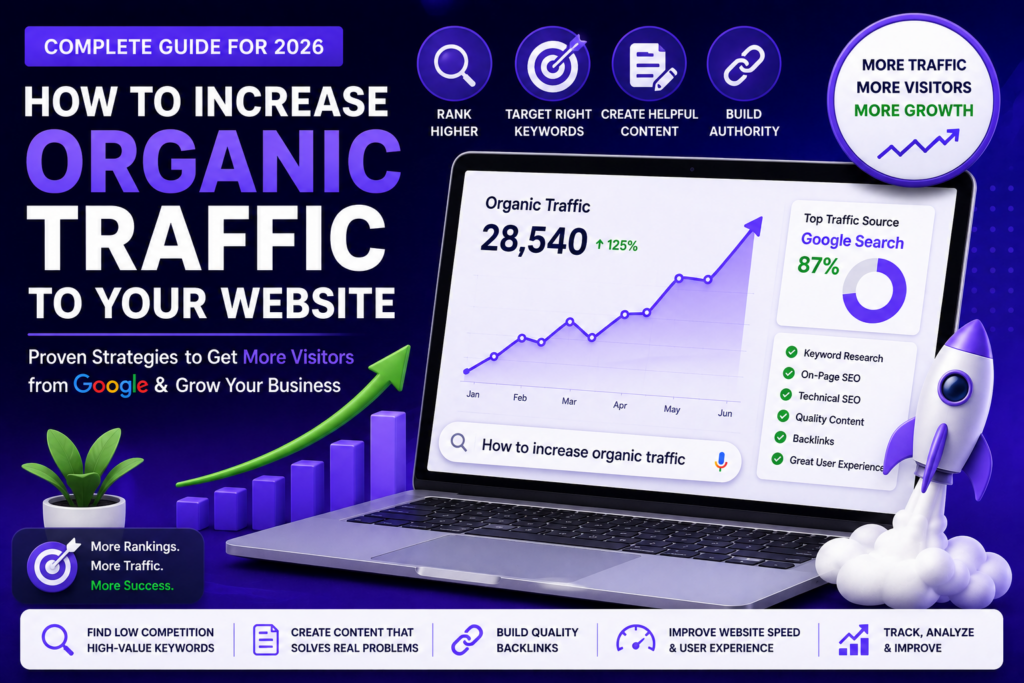
How to Increase Organic Traffic to Your Website (Complete Guide for 2026)
Every website owner eventually asks the same question:
How can I get more traffic?
Not temporary traffic. Not paid traffic. Not traffic that disappears the moment advertising stops.
Organic traffic remains one of the most valuable growth channels because it creates long-term visibility and sustainable results.
Unlike paid advertisements, organic traffic compounds over time. A well-written article published today can continue generating visitors months or even years later.
However, increasing organic traffic in 2026 is no longer simply about publishing random articles and hoping Google sends visitors.
Search engines now evaluate expertise, usefulness, user behavior, structure, technical performance, and content quality more deeply than ever.
According to Google Helpful Content guidance, content should prioritize people rather than search engines.
This guide explains practical strategies that actually help websites grow organic traffic.
📌 What Is Organic Traffic?
Organic traffic refers to visitors who discover your website through unpaid search results.
For example, someone searches on Google:
“How to secure WordPress website”
If your article appears and receives clicks naturally, that visitor becomes organic traffic.
This differs from paid traffic, social traffic, or referral traffic.
Organic traffic often converts better because users are actively searching for information or solutions.
🎯 Why Organic Traffic Matters
Paid campaigns stop producing visitors once budgets disappear.
Organic traffic behaves differently.
Strong content often continues attracting visitors long after publication.
Organic visitors may become subscribers, readers, customers, or returning users.
For websites like Preneurs, this creates additional opportunities:
AdSense revenue.
Theme sales.
Hosting customers.
Brand visibility.
Long-term authority.
🧠 Stop Publishing Random Content
This is one of the biggest reasons websites struggle.
Many websites publish disconnected articles:
A hosting article today.
A movie review tomorrow.
A gadget article next week.
This creates weak topical signals.
Search engines increasingly reward topical authority.
Focus on connected content ecosystems.
Preneurs already follows this model through WordPress, SEO, hosting, blogging, and monetization topics.
🔍 Start With Keyword Research
Content should begin with demand.
Instead of guessing what people want, identify what users are already searching for.
Use tools such as:
Google autocomplete suggestions.
Search Console performance reports.
Long-tail keywords often create stronger opportunities for new websites.
These phrases usually carry lower competition and clearer intent.
📈 Build Content Clusters
Publishing one article about SEO rarely creates authority.
Publishing related content creates stronger topical depth.
For example:
SEO Basics → Keyword Research → Technical SEO → Backlinks → Search Console → Analytics
These connected pieces reinforce one another.
This strategy supports topical authority.
Search engines increasingly understand topic relationships.
⚡ Improve Existing Content
Many website owners focus only on new content.
Existing content often contains hidden opportunities.
Update articles regularly.
Add examples.
Improve internal links.
Refresh screenshots.
Expand weak sections.
Improve title CTR.
Older content improvements often generate faster gains than publishing entirely new articles.
🔗 Strengthen Internal Linking
Internal links help search engines understand content relationships.
They also encourage visitors to explore more pages.
This improves engagement.
Whenever new content is published, connect it naturally with existing relevant content.
Large websites often excel at this.
Strong internal structures quietly support growth.
📱 Improve User Experience
Search engines increasingly analyze user experience signals.
Slow websites frustrate visitors.
Poor mobile experiences increase bounce rates.
Complicated navigation creates confusion.
Good user experience means:
Fast pages.
Readable layouts.
Clear navigation.
Mobile responsiveness.
Simple design.
Helpful content.
Small improvements often compound over time.
🚀 Optimize Technical SEO
Content alone cannot solve everything.
Technical foundations matter.
Check:
Indexing status.
Sitemap submission.
Broken links.
Core Web Vitals.
Mobile usability.
Structured data.
Google Search Console can help identify issues:
🤝 Earn Authority Signals
Search engines evaluate trust.
Backlinks still contribute.
Brand mentions help.
User engagement matters.
Community participation helps visibility.
Authority usually develops gradually rather than instantly.
🤖 Organic Traffic in the AI Search Era
Search continues evolving.
AI systems increasingly evaluate content usefulness, topic relationships, expertise, and user satisfaction.
Keyword stuffing and shortcuts continue becoming less effective.
Helpful content becomes more important.
Google explains this through its Helpful Content System.
Write for people first.
Optimization should support value, not replace it.
⚠️ Common Organic Traffic Mistakes
Publishing random content.
Ignoring search intent.
Weak internal links.
No keyword research.
Ignoring technical SEO.
Expecting instant results.
Buying spam backlinks.
Weak user experience.
These mistakes often limit growth.
💡 Practical Advice for Preneurs
Preneurs already has strong structural advantages.
Content planning follows clusters rather than random publishing.
WordPress themes, hosting, troubleshooting guides, SEO education, and monetization topics naturally reinforce one another.
This ecosystem approach creates stronger authority over time.
Instead of chasing quick wins, continue building helpful resources.
❓ FAQs
1. What is organic traffic?
Visitors from unpaid search results.
2. Can new websites get organic traffic?
Yes.
3. Is keyword research necessary?
Absolutely.
4. Do backlinks matter?
Yes.
5. Can content updates help?
Very often.
6. Does website speed matter?
Yes.
7. What are content clusters?
Groups of connected articles.
8. How long does SEO take?
Usually months.
9. Does AI affect SEO?
Increasingly yes.
10. Should I publish daily?
Quality matters more than quantity.
Final Thoughts
Increasing organic traffic is rarely the result of one tactic.
Strong websites grow because many improvements work together.
Content quality, search intent, structure, user experience, and authority combine over time.
Organic traffic is not built through shortcuts. It is built through systems.