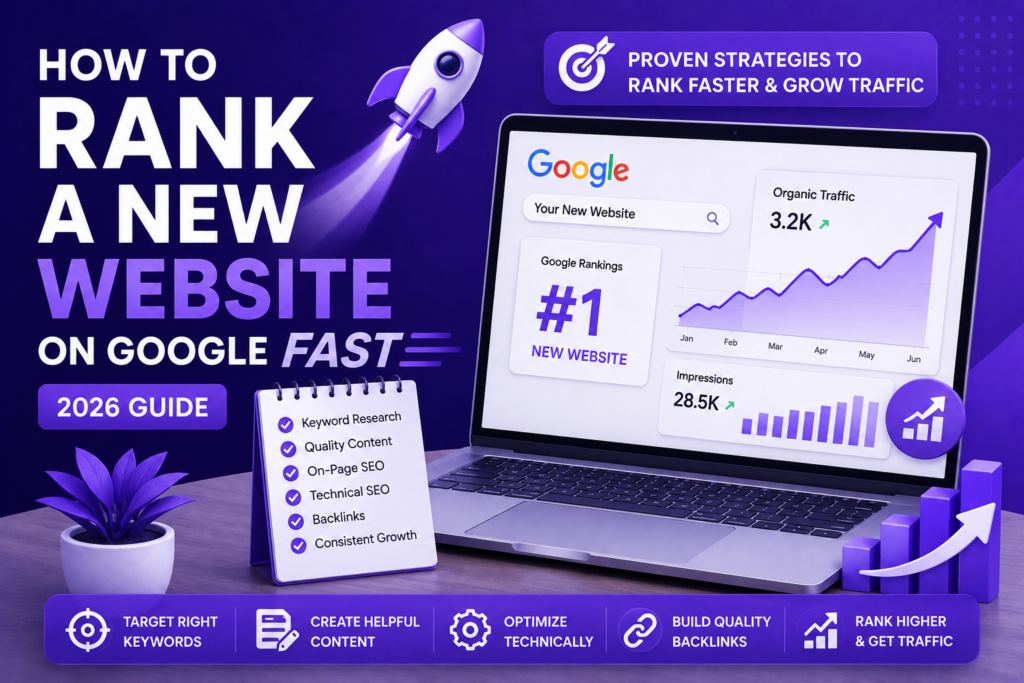
How to Rank a New Website on Google Fast (2026 Guide)
Launching a new website is exciting. You buy a domain, set up hosting, publish content, and wait for visitors. Then reality hits. Days pass. Weeks pass. Sometimes even months pass without meaningful traffic.
This is where many beginners become frustrated.
The most common question becomes: “How can I rank my new website on Google fast?”
The good news is that ranking a new website is possible. The less exciting truth is that there are no magic tricks. Google rewards trust, consistency, quality, and relevance. Websites rarely jump to the top overnight.
However, there are proven strategies that can dramatically improve your chances.
According to Google Helpful Content guidance, creating useful content designed for people remains one of the strongest long-term ranking strategies.
This guide explains practical steps beginners can take to accelerate growth without relying on risky shortcuts.
📌 Understand an Important Truth First
Before discussing tactics, it is important to understand one reality: new websites start with almost no trust signals.
Search engines know very little about them.
Large websites often have years of content, backlinks, authority, and user engagement. New websites start at zero.
This does not mean new websites cannot rank.
It simply means your strategy must be smarter.
Rather than competing immediately for massive keywords, you build authority gradually.
🎯 Start With Keyword Strategy, Not Content Quantity
One of the biggest beginner mistakes is publishing random articles without research.
Many website owners write content based on assumptions instead of search demand.
Instead, begin with keyword research.
Look for long-tail keywords with lower competition and clear search intent.
For example:
Instead of targeting “SEO,” target “SEO checklist for WordPress beginners.”
Instead of targeting “hosting,” target “best WordPress hosting for beginners.”
Long-tail keywords often rank faster because competition is lower.
You can use tools such as KeywordTool.io, AnswerThePublic, or Google suggestions.
🧠 Build Content Clusters Instead of Isolated Posts
Search engines increasingly reward topical authority.
Publishing one article about SEO does not make a website an authority.
Publishing a connected group of articles creates stronger signals.
For example:
SEO Basics → Keyword Research → On-Page SEO → Technical SEO → Search Console → Analytics → Backlinks
This connected structure tells search engines your website covers the topic comprehensively.
Preneurs is already following this strategy.
This creates long-term advantages.
📈 Focus on Search Intent
Many websites fail because they answer the wrong question.
Ranking is not only about keywords.
It is about satisfying intent.
If users search “how to fix WordPress database error,” they want a solution immediately.
They do not want a broad history lesson about databases.
Analyze existing top results and understand what users expect.
Then create something more useful.
⚡ Publish High-Quality Content Consistently
Consistency matters.
Publishing one article and disappearing for months creates weak growth signals.
This does not mean publishing low-quality content daily.
Quality always wins.
For new websites, one excellent article daily or several strong articles weekly often works better than flooding your website with weak content.
Google increasingly rewards depth and usefulness.
According to Google SEO Starter Guide, content quality and accessibility remain central SEO foundations.
🔍 Submit Pages Through Google Search Console
Many beginners publish content and simply wait.
Instead, actively request indexing.
After publishing content:
Open Google Search Console.
Use URL Inspection.
Request indexing.
This does not guarantee instant rankings, but it often accelerates discovery.
🔗 Build Internal Links Early
Internal links help search engines understand your content relationships.
They also improve user experience.
Whenever you publish new content, connect it with older articles naturally.
This creates stronger topic structures.
Our previous article on internal linking explained this in detail.
🚀 Improve Website Speed
Many websites lose opportunities because of poor performance.
Slow websites frustrate users and create negative signals.
Use Google PageSpeed Insights to evaluate speed.
Improve image optimization, caching, hosting quality, and unnecessary scripts.
Even small speed improvements can improve user experience.
📱 Prioritize Mobile Experience
Most users now browse websites on mobile devices.
Google uses mobile-first indexing.
This means mobile performance significantly affects rankings.
Your website should be responsive, readable, and fast.
🤝 Earn Early Backlinks Naturally
Backlinks help build authority.
However, beginners often rush into buying links.
A safer approach involves:
Guest contributions.
Resource pages.
Communities.
Creating highly shareable content.
One good backlink often matters more than many weak links.
🤖 SEO in the AI Search Era
Search engines increasingly use AI systems to evaluate context, quality, expertise, and usefulness.
This changes SEO priorities.
Keyword stuffing and shortcuts continue losing effectiveness.
Helpful content becomes increasingly important.
Google explains this through its Helpful Content system.
Content should satisfy people first.
⚠️ Common Mistakes New Website Owners Make
Publishing random content.
Targeting impossible keywords.
Ignoring internal links.
Buying spam backlinks.
Expecting overnight success.
Focusing on quantity instead of usefulness.
These mistakes delay growth significantly.
💡 Practical Advice for Preneurs
Preneurs already has an advantage because content is being planned strategically.
Rather than publishing isolated topics, content clusters are being built around WordPress, SEO, blogging, hosting, and monetization.
This structure supports topical authority and long-term rankings.
Over time, these articles reinforce each other.
❓ FAQs
1. How long does a new website take to rank?
Often several weeks to months.
2. Can a new website rank quickly?
Yes, with proper strategy.
3. Are backlinks necessary?
Helpful but not always immediately required.
4. Does website age matter?
Trust often increases over time.
5. Should I publish daily?
Quality matters more than frequency.
6. Is indexing instant?
No.
7. Can low competition keywords help?
Yes, significantly.
8. Should I focus on content clusters?
Absolutely.
9. Can AI content rank?
If genuinely useful and reviewed carefully.
10. Is SEO a long-term process?
Yes.
Final Thoughts
Ranking a new website is not about tricks. It is about building trust strategically.
Focus on useful content, clear structure, search intent, and consistent improvement.
New websites rarely win by publishing more content. They win by publishing smarter content.