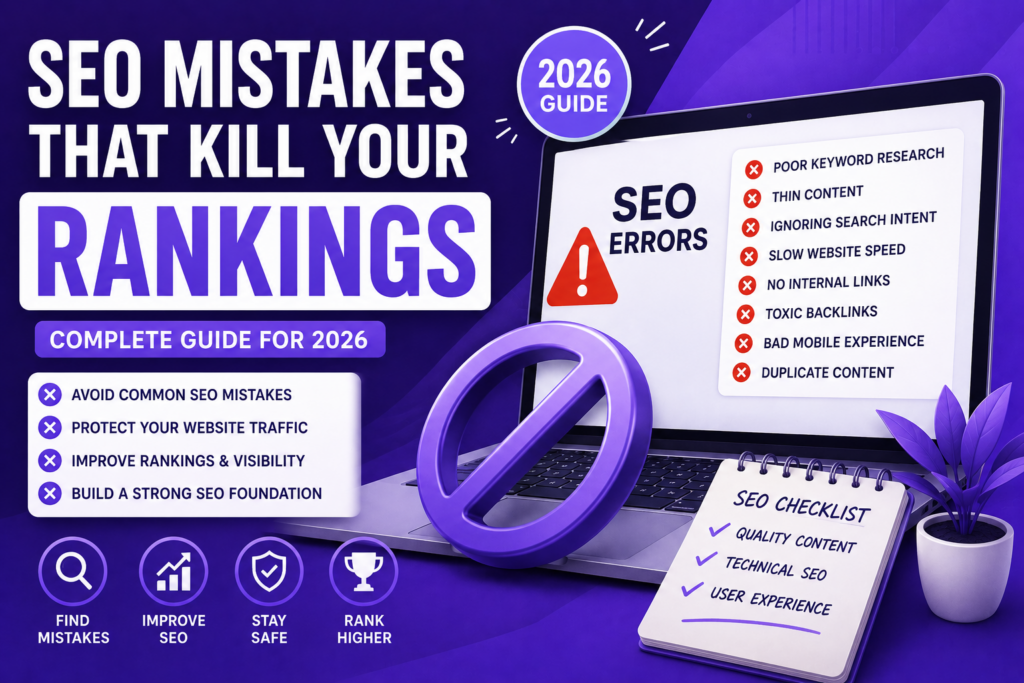
SEO Mistakes That Kill Your Rankings (Complete Guide for 2026)
SEO can feel frustrating, especially for beginners. You publish content, optimize keywords, and wait for traffic. Sometimes nothing happens. Even worse, a website that was performing well suddenly loses rankings.
Many website owners immediately blame Google updates, competition, or bad luck. But in reality, ranking problems often come from internal mistakes.
The difficult part is that SEO mistakes are not always obvious. Some mistakes produce immediate damage while others quietly reduce performance over time.
In 2026, search engines are far more advanced than they were years ago. They evaluate quality, user satisfaction, trust signals, page experience, and content usefulness.
According to Google Helpful Content documentation, websites should focus on people-first content rather than creating content solely for search engines.
This guide explains the most common SEO mistakes that damage rankings and how to avoid them.
📌 Why SEO Mistakes Matter More in 2026
Years ago, websites could sometimes rank through shortcuts.
Keyword stuffing, weak content, and manipulative tactics occasionally worked.
Search engines today operate very differently.
AI systems understand relationships between topics, identify low-quality patterns, and evaluate user satisfaction signals more effectively.
This means mistakes can become more visible.
Small problems repeated across dozens of pages can create large ranking issues.
🧠 Mistake #1: Writing for Search Engines Instead of Humans
This remains one of the biggest SEO mistakes.
Some website owners focus so heavily on algorithms that they forget real people are reading the content.
The result often sounds unnatural.
Content becomes repetitive, robotic, and difficult to read.
Search engines increasingly reward content that solves problems naturally.
Instead of asking:
“How many times should I repeat my keyword?”
Ask:
“Does this genuinely help someone?”
This shift changes everything.
🔍 Mistake #2: Ignoring Search Intent
Search intent explains why someone performs a search.
Many websites target correct keywords but provide the wrong type of content.
For example:
If users search “how to fix WordPress database error,” they expect practical troubleshooting steps.
Publishing broad theory may disappoint users.
Search engines monitor these signals.
Study existing top-ranking pages and understand what users expect.
⚡ Mistake #3: Publishing Thin Content
Some websites prioritize volume over value.
Publishing dozens of weak articles rarely creates strong authority.
Thin content often lacks depth, practical examples, context, and completeness.
Search engines increasingly favor comprehensive content.
This does not mean every article must be extremely long.
It means content should satisfy the topic fully.
Helpful resources from Google SEO Starter Guide reinforce this principle.
📈 Mistake #4: Targeting Impossible Keywords
Many beginners immediately target extremely competitive keywords.
For example:
Trying to rank a new website for “SEO” or “hosting” can be unrealistic.
Large websites may already dominate those spaces.
Instead, focus on long-tail keywords.
Long-tail terms often have lower competition and stronger intent.
This creates faster opportunities.
🔗 Mistake #5: Ignoring Internal Linking
Publishing articles without connecting them creates isolated content.
Search engines use internal links to understand topic relationships.
Users also benefit from relevant recommendations.
Strong websites rarely publish disconnected content.
They build ecosystems.
For Preneurs, SEO → WordPress → Hosting → Analytics → Tutorials should connect naturally.
🚀 Mistake #6: Ignoring Technical SEO
Even excellent content struggles when technical foundations are weak.
Examples include:
Broken pages.
Slow performance.
Indexing issues.
Mobile usability problems.
Search engines need efficient access to content.
Technical issues often quietly damage rankings.
Learn more through Google Search Console.
📱 Mistake #7: Poor Mobile Experience
Most users browse on mobile devices.
Google uses mobile-first indexing.
Websites that perform poorly on smaller screens often lose opportunities.
Text should remain readable.
Navigation should feel simple.
Pages should load quickly.
📊 Mistake #8: Ignoring Website Speed
Users dislike slow websites.
Search engines understand this.
If pages load slowly, users leave faster.
That creates weaker engagement signals.
Use Google PageSpeed Insights to identify improvements.
Optimizing images and improving hosting quality can help significantly.
🤝 Mistake #9: Buying Spam Backlinks
This remains a common mistake.
Many sellers promise hundreds of backlinks quickly.
Unfortunately, low-quality links can create long-term damage.
Authority should be earned gradually.
Quality matters more than quantity.
Google explains this through Search Spam Policies.
🤖 Mistake #10: Publishing AI Content Without Human Review
AI tools can help content creation.
However, publishing raw AI output without editing often creates problems.
Some content becomes repetitive or inaccurate.
AI should support expertise, not replace it.
Human review remains essential.
📉 Mistake #11: Ignoring Existing Content
Many website owners focus only on publishing new articles.
Existing content often receives little attention.
Updating old content can improve rankings dramatically.
Refresh examples.
Improve internal links.
Add missing sections.
SEO is ongoing.
⚠️ Mistake #12: Expecting Instant Results
SEO requires patience.
Some websites expect immediate traffic growth.
When results do not appear quickly, consistency disappears.
Authority develops gradually.
Strong websites often compound growth over time.
💡 Practical Advice for Preneurs
Preneurs already has an advantage because the content plan focuses on connected topics and content clusters.
The goal should not be publishing the most articles.
The goal should be publishing the most useful articles.
Long-term quality usually wins.
❓ FAQs
1. What is the biggest SEO mistake?
Ignoring user intent.
2. Does keyword stuffing still work?
No.
3. Can AI content rank?
Yes, when edited and helpful.
4. Does website speed matter?
Yes.
5. Are backlinks still important?
Yes.
6. Can thin content hurt rankings?
Yes.
7. Should I update old content?
Absolutely.
8. Are long-tail keywords useful?
Very useful.
9. Is mobile optimization important?
Yes.
10. How quickly does SEO work?
Usually over months.
Final Thoughts
SEO success is not only about what you do correctly. It is also about what mistakes you avoid.
Most ranking problems come from fundamentals rather than hidden algorithm secrets.
Build useful content, improve user experience, avoid shortcuts, and rankings usually become easier over time.