SEO vs Paid Ads: Which is Better for Your Business in 2026?
If you own a website, run a business, or plan to grow online, one question eventually appears:
Should I invest in SEO or paid advertising?
At first glance, the answer seems simple. Paid ads generate traffic immediately while SEO takes time.
But once businesses begin spending money, reality becomes more complicated.
Some businesses spend heavily on advertising and see short-term traffic with little long-term value. Others focus entirely on SEO and become frustrated because results arrive slowly.
The truth is that neither strategy is universally better. The right choice depends on goals, timelines, competition, and business models.
In 2026, online growth is increasingly influenced by search algorithms, AI systems, user behavior, and content quality.
Understanding both approaches helps businesses make smarter decisions.
According to Google Ads documentation, advertising allows businesses to appear quickly in search results, while SEO builds long-term visibility.
📌 What Is SEO?
SEO (Search Engine Optimization) refers to improving your website so it appears naturally in unpaid search results.
This involves:
Content creation.
Keyword research.
Technical optimization.
Internal linking.
Backlinks.
User experience improvements.
SEO aims to create long-term visibility.
Instead of paying for every visitor, strong SEO creates sustainable traffic.
📌 What Are Paid Ads?
Paid ads allow businesses to purchase visibility.
Platforms such as Google Ads display your content above organic search results.
You usually pay when someone clicks.
This approach creates immediate exposure.
Advertising can also appear across search results, videos, mobile applications, shopping results, and websites.
🎯 Biggest Difference Between SEO and Paid Ads
The largest difference is simple:
SEO earns visibility.
Advertising rents visibility.
Paid traffic often stops once budgets stop.
SEO usually continues generating traffic even after content publication.
This difference dramatically affects long-term strategy.
🧠 Speed of Results
Paid advertising wins when speed matters.
A campaign can generate visibility immediately.
This helps product launches, promotions, seasonal campaigns, and time-sensitive goals.
SEO behaves differently.
Search engines need time to crawl, evaluate, and trust content.
New websites often require months before seeing meaningful growth.
However, traffic gained through SEO often becomes more sustainable.
📈 Long-Term Return on Investment
Businesses frequently evaluate ROI.
Initially, paid advertising may seem attractive because results appear quickly.
However, long-term costs continue.
Every visitor usually requires spending.
SEO requires investment too:
Content creation.
Website optimization.
Time.
Strategy.
But successful content often keeps generating visitors repeatedly.
Over time this can create stronger cumulative returns.
💰 Cost Comparison
Paid advertising can become expensive in competitive industries.
Keywords related to finance, legal topics, insurance, or software sometimes carry high costs.
SEO often requires upfront effort rather than direct payment for each click.
This makes SEO attractive for businesses seeking sustainable growth.
🔍 User Trust Differences
Users understand advertising exists.
Many people skip sponsored results and move directly toward organic listings.
Organic visibility often creates stronger trust because users perceive rankings as earned rather than purchased.
Trust can strongly influence conversions.
📱 Which Works Better for New Websites?
New websites often struggle with SEO initially because authority takes time.
Advertising can create early exposure.
However, relying entirely on ads creates long-term dependence.
A balanced approach often works better.
Early campaigns create visibility while SEO builds long-term assets.
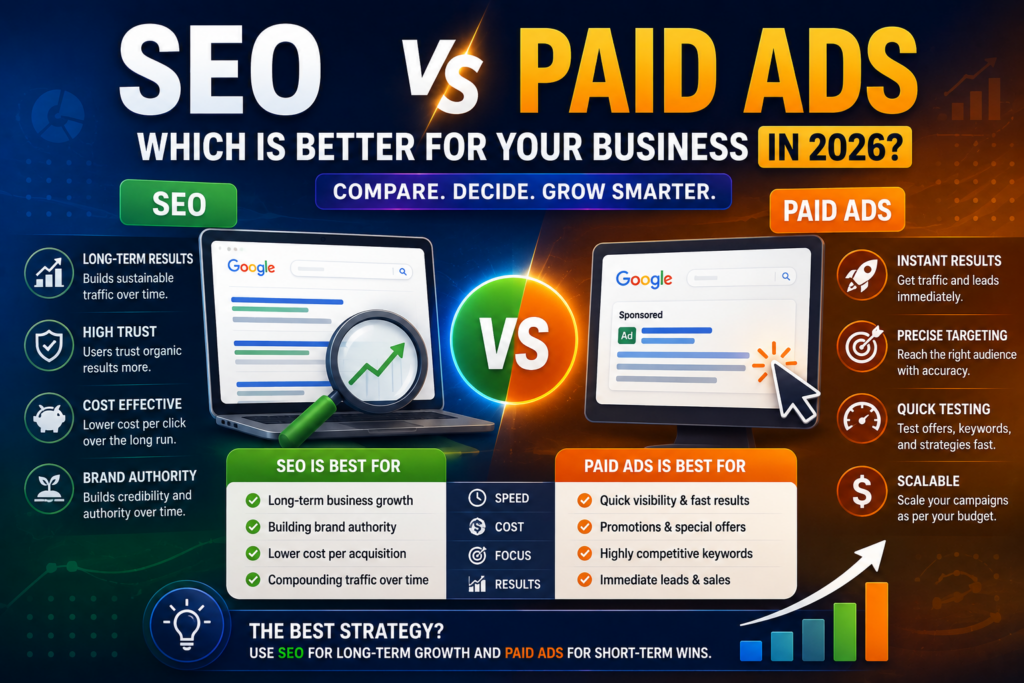
🚀 SEO Advantages
Long-term traffic potential.
Compounding results.
Higher trust signals.
Lower long-term acquisition cost.
Brand authority growth.
Better content ecosystem development.
⚡ Paid Ads Advantages
Immediate traffic.
Precise audience targeting.
Fast testing opportunities.
Useful for launches.
Scalable campaigns.
Predictable visibility.
🤖 SEO and Advertising in the AI Era
Search engines increasingly integrate AI systems.
User expectations continue changing.
Helpful content increasingly matters.
Google’s Helpful Content guidance emphasizes usefulness and user satisfaction.
Strong content supports both SEO and advertising.
Even paid campaigns perform better when landing pages provide excellent experiences.
⚠️ Common Mistakes Businesses Make
Expecting instant SEO success.
Relying entirely on ads.
Ignoring content quality.
Stopping SEO because early results feel slow.
Running advertisements toward weak landing pages.
Growth usually requires systems rather than shortcuts.
💡 Practical Advice for Preneurs
For Preneurs, SEO should remain a primary long-term strategy because the content ecosystem already supports WordPress, hosting, blogging, and monetization.
However, occasional paid campaigns could amplify strategic pages such as hosting packages or premium theme launches.
SEO builds the foundation.
Advertising can accelerate specific goals.
❓ FAQs
1. Is SEO free?
No, it requires time and effort.
2. Are paid ads faster?
Yes.
3. Which creates long-term traffic?
SEO.
4. Can new websites use ads?
Yes.
5. Does SEO still matter in 2026?
Absolutely.
6. Which costs more?
Often paid ads long term.
7. Can SEO and ads work together?
Yes.
8. Do users trust organic results more?
Often yes.
9. Should beginners start with SEO?
Usually yes.
10. Is SEO slow?
Compared with ads, yes.
Final Thoughts
SEO and paid advertising should not always be viewed as competitors.
One builds long-term authority while the other creates immediate visibility.
The smartest strategy is not choosing one side blindly. The smartest strategy is understanding when to use each.