What is Domain Authority & How to Increase It (2026 Guide)
If you spend enough time learning SEO, you will eventually come across the term “Domain Authority” or DA. Many beginners become obsessed with it. Some website owners check their DA score every week, while others believe increasing Domain Authority automatically guarantees rankings.
The reality is more nuanced.
Domain Authority is useful, but understanding what it actually means is more important than chasing a number. In 2026, SEO success depends on a combination of content quality, authority, user experience, and trust signals.
This guide will explain Domain Authority in simple language, how it works, why it matters, and practical ways to improve it.
For reference, Domain Authority itself is not a metric created by Google. It was introduced by Moz as a predictive metric designed to estimate how likely a website is to rank in search results.
📌 What is Domain Authority?
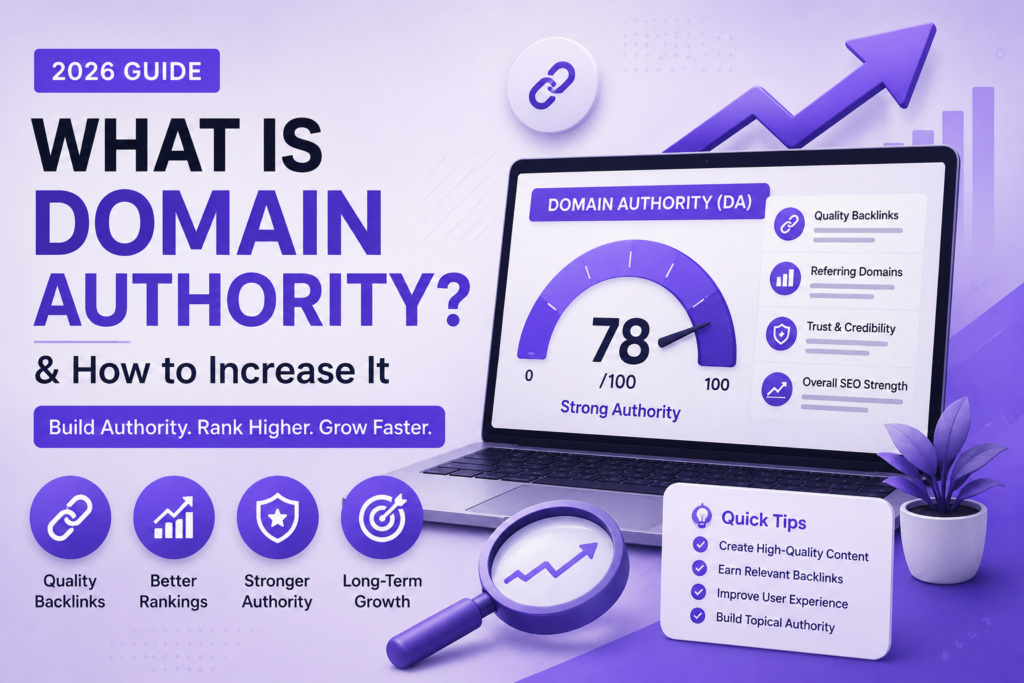
Domain Authority (DA) is a score developed by Moz that predicts how strong a website may be in search engine rankings. The score ranges from 1 to 100.
Generally speaking, higher scores indicate stronger authority.
However, it is important to understand that Google does not officially use Domain Authority as a ranking factor.
Instead, DA attempts to estimate authority by analyzing multiple signals such as backlink quality, link profile strength, and website reputation.
Think of Domain Authority as a temperature gauge rather than a guarantee.
It helps you compare relative strength between websites but should not become your only SEO focus.
🎯 Why Beginners Get Confused About DA
Many new website owners believe DA directly controls rankings.
This misunderstanding often creates unnecessary pressure.
For example, a website with lower Domain Authority can still outrank larger websites if it provides better content and satisfies user intent more effectively.
Google’s systems evaluate many factors beyond external metrics.
According to Google Helpful Content guidance, content usefulness and user satisfaction remain critical.
🧠 How Domain Authority is Calculated
Moz uses machine learning and multiple SEO signals to estimate authority.
Although the exact formula changes over time, several elements strongly influence scores.
Backlink quality matters.
The number of referring domains matters.
The authority of websites linking to you matters.
Overall link profile health matters.
In simple terms, DA attempts to estimate whether your website has earned enough trust and recognition across the web.
📊 Domain Authority vs Page Authority
Many people confuse Domain Authority with Page Authority.
Domain Authority evaluates your overall website.
Page Authority evaluates the ranking strength of an individual page.
For example, your website homepage may have strong authority while a newly published blog post may have low authority initially.
Both metrics provide useful insights.
However, neither should replace a broader SEO strategy.
🔍 Does Google Use Domain Authority?
This is one of the most common SEO questions.
The short answer: no.
Google representatives have repeatedly clarified that Google does not use Moz Domain Authority scores as a direct ranking factor.
You can review Google guidance through Google SEO Starter Guide.
However, some factors influencing DA—such as backlinks, authority, and trust—also influence search performance indirectly.
That is why improving authority-related signals still helps.
📈 Why Domain Authority Still Matters
Although Google does not officially use Domain Authority, many marketers still find it useful for comparison and competitive analysis.
DA helps you:
Understand website growth trends.
Compare your website against competitors.
Evaluate potential backlink opportunities.
Estimate relative authority levels.
Track long-term SEO progress.
Just remember: treat DA as one signal among many.
⚡ How to Increase Domain Authority
Create High-Quality Content Consistently
Authority starts with content.
Search engines and users reward websites that consistently solve problems and provide value.
Publishing shallow articles occasionally will not create authority.
Publishing detailed, trustworthy content repeatedly can.
This is exactly why Preneurs is building structured content clusters rather than random articles.
Earn High-Quality Backlinks
Backlinks remain one of the strongest authority signals.
However, quality matters far more than quantity.
One strong backlink from a respected website often provides more value than dozens of weak links.
Focus on relevance and trust.
Our previous backlink guide explained this concept in detail.
Improve Internal Linking
Internal links distribute authority throughout your website.
When important pages receive stronger internal support, search engines understand their significance better.
This creates a healthier content structure.
Learn more from Google’s documentation on links.
Build Topical Authority
Publishing isolated content creates weak authority.
Publishing connected content clusters creates stronger authority.
For example:
WordPress → SEO → Analytics → Hosting → Security → Troubleshooting.
Together these topics build expertise.
Search engines increasingly reward websites that cover subjects comprehensively.
Remove Toxic Links Carefully
Not every backlink helps.
Spam links from irrelevant or suspicious websites may create problems.
Monitor your backlink profile periodically.
Google provides a disavow process for unusual cases.
However, use it cautiously.
🤖 Domain Authority in the AI Search Era
Modern search systems increasingly rely on AI models that evaluate expertise, context, and trustworthiness.
This means authority is no longer just about backlinks.
Content quality, brand recognition, user engagement, and expertise signals increasingly matter.
EEAT principles are becoming stronger over time.
Strong websites build authority naturally through trust and consistency.
⚠️ Common Mistakes Website Owners Make
Many people obsess over DA scores and ignore actual SEO fundamentals.
Others purchase low-quality backlinks hoping for quick improvements.
Some compare new websites against large established brands and become discouraged.
SEO growth is gradual.
Authority develops over time.
Focus on steady improvement rather than numbers.
💡 Practical Advice for Preneurs
For Preneurs, Domain Authority should be viewed as a long-term outcome rather than a target.
The strategy already being implemented—high-quality content, content clusters, WordPress tutorials, SEO guides, and troubleshooting content—naturally supports authority growth.
Instead of chasing DA directly, focus on helping users.
Authority will follow.
❓ FAQs
1. What is Domain Authority?
A score created by Moz to estimate website authority.
2. Does Google use DA?
No, not directly.
3. What is a good DA score?
It depends on your niche and competitors.
4. Can new websites have high DA?
Usually not initially.
5. Do backlinks increase DA?
Yes, quality backlinks can help.
6. Is DA more important than content?
No.
7. Can low DA sites rank?
Yes.
8. How often does DA update?
Moz updates it periodically.
9. Can I increase DA quickly?
Not sustainably.
10. Should I obsess over DA?
No, focus on overall SEO health.
Final Thoughts
Domain Authority is useful as a comparison tool, but it should not become your SEO destination.
Strong authority comes from solving problems, creating trust, and publishing consistently valuable content.
Focus on building a strong website — and authority becomes a byproduct, not a goal.